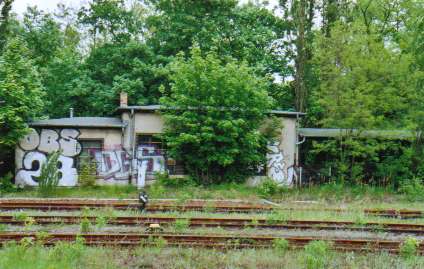
Later that month, refugee trains no longer stop in down-town terminals. They are brought out to the old engine supply depot at Schönholz, with its multiple tracks. There’s a ramp at one side, though too short for their purposes, and a sturdy shack, suitable for storing supplies and offering shelter from the cold. They work in two shifts of twelve hours each, and now they are on their own. After the initial instruction on the drill here, (“anyone need to be told to stay OFF those tracks, haha?”) there are no adults other than engineers, shunting rolling stock back and forth out of the depot, or moving engines up to the water gusher, suspended above, or taking on coal, the only commodity protected by a roof. The engineers wave to them, moving about with the pale, slim fingers of staff lights clipped onto their sooty gear. On cloudy nights, with blackout in the shack hermetic, they truly work in the dark.
Trains arrive, doors are opened at once, the kids carry wash baskets with unwrapped liverwurst sandwiches along and pass them up to eager, grimy hands. Fast, hurry, the train is so very long and this time they really want to reach everybody, get at least one sandwich to all the refugees. Nadja and the Pipsqueak pull along a wagon bearing a coffee urn but so few people have cups or mugs, and their own are used up so fast. Most people just ask for water, want to fill small bottles, and a few enquire about the latest news from the front.
“Where’s Ivan?” And the kids mumble something comforting in response.
Lie. Tell the same lies every day.
Then they run back to the shack for more sandwiches. Another basket is ready, but feverishly, Anna, Lilly and Emma are preparing more. They have to leave the ramp to reach the last cars, stumble along the icy trackage, calling ahead.
The third night out here, Anna is looking for more butter in the small box, slices of bread lying in rows on the big cutting board waiting to be spread upon.
“Do you have the butter out already, Lilly?” But there is no answer.
As Anna looks around she discovers the visitor, a heavy-set middle-aged man in brown party uniform, emerging from the small supply room behind Lily, who is staring at him in disbelief. The ‘gold pheasant’, as Berliners have long dubbed the party brass, holds an entire liverwurst in one hand, and two half pound lots of butter in the other, now heading for the door.
He shrugs at Lilly who is blocking the way. Leaves without a word.
“Do you know this is the second time he has been here already?” Lilly is enraged. “What do we do next time? We’re short of stuff as it is. Any ideas?”
“No. Can we hide anything? Lock the supplies away?”
“That door doesn’t lock. I checked already.”
They tell the others to watch out for him. At least he should know that they have his number. But he doesn’t return for a week. His wife turns up instead. She makes off with cream cheese and a pound of coffee. Runs into the Pipsqueak who stands outside in the dark, stamping his feet and pounding his cold mitts together.
“Next time he comes, let’s just beat him up but good,” he shouts after her.
An hour later, at five a.m., they find the Pipsqueak at the end of the ramp, curled up on the garbage dump, amid empty cans and bottles, fast asleep. They carry him inside and massage his back, hands and feet, but he is fine, just cold.
“I was following her, and then I fell… couldn’t see where I was going,” he says.
This is the night for visitors. The door opens and three odd looking men, no boys, come in, hands in their pockets. They all wear identical white shawls wrapped around the neck, black jackets and their slicked back hair hasn’t seen the inside of a barber shop in a year.
They line up against the wall, saying nothing.
Fritze is on duty today and he is not surprised.
“So what’s the story here?” he says. “What’s up?” Calmly looks at each in turn. They close their eyes, bored.
“You collecting alms for the ‘Winterhilfe’?”
“No,” says one, “government bought enough tanks already.”
“Not true, of course,” says Fritze, “but we won’t argue the point today. So can we be of service at all?”
A hint of menace is in the air. Just a hint. But Fritze folds his hands behind his head, raising his eyebrows. One of them points toward the door and they slip out.
“Never a dull moment,” says Fritze. “The Edelweiss Pirates. I should have introduced you, except I don’t know their names. Popping up like mushrooms, those guys. All over the place.”
“And what IS the story?” says Anna. “Do you know?”
“They disapprove of our Führer,” says Fritze, “vaguely.”
When Anna and Nadja are on duty the next time, they have to fight through a lot of snow and slush. No one shovels anything out here, and the supply truck has simply dropped a heap of boxes off at the end of the road and left. The kids work in twos, carrying the heavy load to the shack.
The railway yards are busy all evening, refurbishing engines, and the girls have to watch their step. Anna pushes open the door and Lilly rushes in with a box and plops it on the floor. In the split second the light beam reaches out, they spot a heavy-set figure, awkwardly picking up something heavy from between tracks and crossing others, disappearing in the dark. Lilly slams the door. Anna just shakes her head.
“Why don’t we tell the truckers to deliver the whole lot to party headquarters in the first place?” she says.
“The scoundrel, no, the—”
But the door opens and the Pipsqueak stumbles across the threshold and drops a bundle on the floor.
“Someone walking around the tracks out there,” he says. “I thought we weren’t supposed to—”
“No. That’s right. It’s pitch dark.”
They go outside for more boxes. Heavy snow clouds hide the moon and thick flakes have begun to fall. Their eyes quickly get accustomed to the dark, have become well trained in the blackout.
Three boxcars have been parked on a siding, partly blocking the view.
Two engines are in the depot, taking on coal. Earlier they had heard them whistle.
There’s the figure, crossing back now empty-handed, clumsily stepping on the ties, looking down, reaching the ramp. The kids don’t make a move.
Watch the figure picking up a heavy object, turning and starting back across the tracks. He appears to be carrying it upright, in front of his face.
At first no one notices the engine that has now begun to move, slowly, quietly, out of the depot, is presently hidden behind the boxcars. They have heard no whistle, peer into the dark without moving. It has picked up steam as it emerges from behind the freight, and is headed for — is headed for —
A piercing shriek emanates from the dark, from the direction of the last track before the bushes, and then they hear a dull thump. The engine never stops, white puffs of smoke whooooof-whoooof into the air, and it’s gone.
The kids make their way across the tracks, touching the boxcars and climbing around them, and there he is, slumped against a light post, a butter box sitting in the slush, a metre from his foot. His uniform is covered in mud and snow and he is badly shaken up, mumbling threats against “that bastard, that engineer”, but ultimately, he seems no worse for wear.
The kids do not help him up. Instead they lift the box out of the snow and carefully retreat to the shack with it.
For the rest of their service out in Schönholz, there will be no further visits by party brass. The Edelweiss Pirates come calling, smoking, silent, but no more looters.